In short
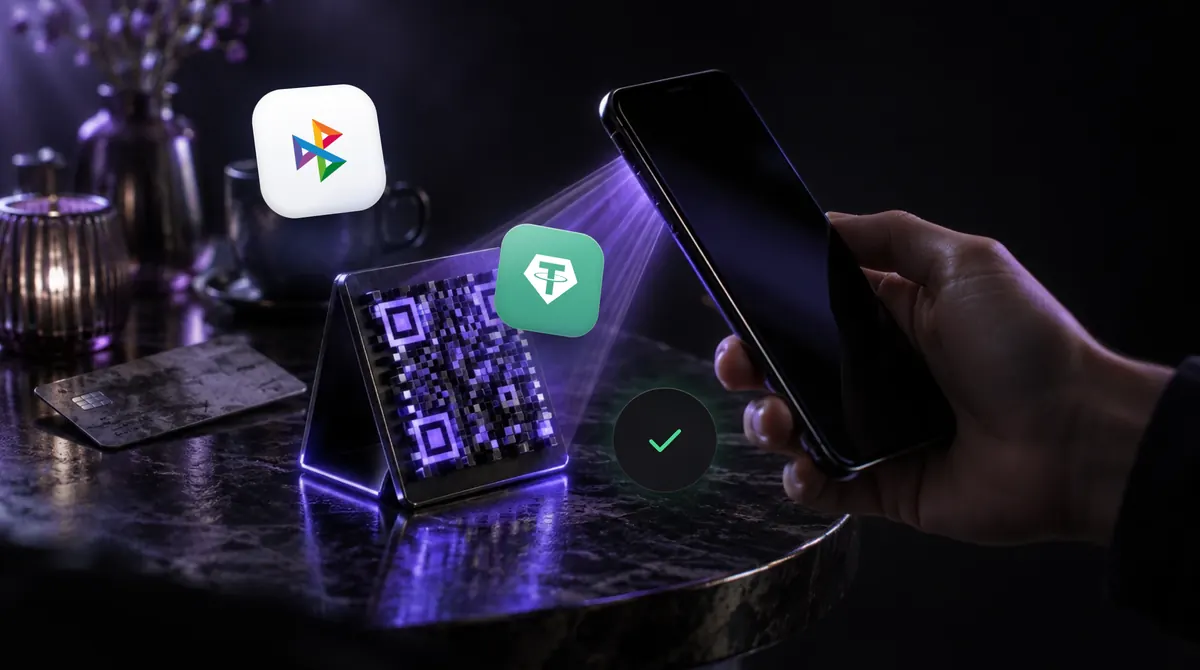
To spend USDT in Russia you don't have to sell it P2P and cash rubles out to a card: in Aura Wallet an SBP QR code is paid straight from your USDT balance, and the shop receives rubles. That way you don't take transfers from strangers onto your card — and the Bank of Russia recommends that banks pay special attention to exactly such transfers.
How people usually spend crypto, and the problem
The usual route: sell USDT on a P2P platform, receive rubles on your card from the buyer, then pay from the card. That route has two weak spots.
- The rubles come from strangers. Every sale is an incoming transfer from another individual. The more often you sell, the more different senders and person-to-person turnover your card shows.
- You don’t know whose money it is. A buyer may pay not with their own money but with the money of someone who was conned by fraudsters. You’ll be the last to find out.
Below is what that can lead to under Russian rules. This isn’t legal advice — it’s a short summary of public Bank of Russia documents and laws, with links to the primary sources (in Russian).
Risk 1. Bank questions under 115-FZ
Russia’s anti-money-laundering law, 115-FZ, requires banks to run internal controls. Under Article 7, paragraph 11 a bank may refuse to carry out an operation if those controls raise suspicion. And under paragraph 14 of the same article, clients must give the bank the information it needs to comply with the law. In practice this looks like a request to “explain the nature of your operations” and some operations restricted until you answer.
Why P2P sales draw attention:
- In Methodological Recommendations No. 16-MR the Bank of Russia listed signs banks should watch for in transfers between individuals: for example, an unusually large number of individual counterparties, large person-to-person turnover, money leaving almost immediately after it arrives, and no ordinary living expenses such as phone, utilities or shopping. When two or more signs match, banks are advised to pay closer attention to the client.
- In Recommendations No. 4-MR the Bank of Russia states outright that a large share of digital-currency operations runs as transfers between individuals through crypto exchangers and exchanges that use cards of front persons (“drops”). Banks are advised to track clients who send money to such drops or receive money from them when buying or selling digital currencies, and to ask them about the nature and purpose of those operations.
So selling your own USDT isn’t banned as such, but regular P2P deals can make your card the subject of a review — and you’ll be the one preparing answers and documents.
Risk 2. Anti-fraud under 161-FZ: held transfers and the Bank of Russia database
Amendments to 161-FZ, the National Payment System law, apply since 25 July 2024. According to the Bank of Russia announcement:
- banks must hold transfers for two days if the recipient appears in the Bank of Russia database of fraudulent operations and attempts;
- for people used to move stolen money, banks disconnect online banking and block cards once information about their part in a fraud scheme arrives through the exchange with law enforcement.
Banks and the Interior Ministry supply data to this database — often called the “drops database”. If your card lands there, the bank may suspend the card and online banking, and when the data came from the Interior Ministry the suspension is mandatory. You can apply to the Bank of Russia to have the data removed; applications take up to 15 working days — the procedure is on the Bank of Russia 161-FZ page. While that’s under way, the card and online banking can’t be used: you can withdraw money and make operations by visiting a bank branch with your passport.
Risk 3. A dishonest buyer
Even on large platforms you’re dealing with a stranger. Possible scenarios:
- Payment “from a third party”. The buyer gets a fraud victim to send you money “for goods” or “for a service” and keeps the USDT. The victim then goes to their bank and the police — and your card is in the transfer history.
- A fake receipt. You’re shown a “receipt” for a transfer that never happened.
- Questions from law enforcement. If the money turns out to be stolen, you may be asked about the transfer’s origin, and your card may end up in the Bank of Russia database described above.
None of this is inevitable, but each case costs time and nerves — and all of them come from rubles reaching your card from outsiders.
The alternative: pay QR codes straight from your USDT balance
If your goal isn’t to “cash out” but to pay in Russia, you can drop the sale step entirely. In Aura Wallet an SBP QR code is paid from your USDT balance: the shop receives rubles, and you see the final amount and rate before paying. You don’t sell USDT to strangers or receive their transfers on your card.
- Open Aura Wallet in Telegram — the @AuraWalletTG_bot bot.
- Tap the round Pay button and point the camera at the SBP QR code.
- Check the bill: the ruble amount, how many USDT will be debited and at what rate.
- Tap Pay. A payment usually takes 5–15 seconds.
| You pay with | USDT from your Aura Wallet balance |
| The shop receives | rubles |
| Fee | no separate fee: the rate and total are shown before paying |
| Rate lock | 2 minutes |
| One payment | 10 to 600,000 ₽ |
| Card and identity check | not needed |
Current rate:QR payment — 1 USDT = 85.15 ₽buying USDT via SBP — 1 USDT = 88.91 ₽ (for amounts from 10,000 ₽)updated Moscow time
Step by step with screenshots: How to pay an SBP QR code with USDT.
P2P cash-out vs QR payments with USDT
| Sell P2P, pay by card | Pay by QR with USDT in Aura | |
|---|---|---|
| Who sends you rubles | buyers you don’t know | no one: the shop gets the rubles |
| Rate | negotiated, each seller has their own | shown in the bill before paying, held for 2 minutes |
| Time | finding a deal, waiting for the transfer, checking it | usually 5–15 seconds |
| Deal with a stranger | yes | no |
| Where it works | wherever your card is accepted | wherever SBP QR codes are accepted |
How to top up your USDT balance
- From an exchange or another wallet — USDT on TRON (TRC-20), 2 USDT fee, 4 USDT minimum, no identity check. Step by step: how to deposit from an exchange.
- From another Aura user — free and instant, including via a payment request in a chat.
Where to pay by QR and where by card
- In Russia — by SBP QR code in shops, cafés, markets and on websites with a QR code or a
https://qr.nspk.ru/…link. Merchant invoices that aren’t SBP QR codes aren’t supported yet. - Abroad and with foreign services — with the virtual Visa card in dollars: 20 USDT once to issue, 2% per top-up from your USDT balance. The card works in 179 countries, but not with Russian merchants.
If it didn’t work
- “Not enough USDT to pay the bill”. Top up the wallet and return to the bill — it doesn’t disappear.
- “The quote is out of date”. More than 2 minutes passed: check the new price and confirm again.
- “Amount outside payment limits”. A payment must be 10 to 600,000 ₽.
- “Merchant invoices aren’t available yet”. It’s an invoice, not an SBP QR code — pay another way.
- The payment failed. No money is debited, and anything reserved returns to your balance automatically. All errors: A QR payment did not go through.
The laws and Bank of Russia recommendations are summarised from public sources as of publication. Checks and restrictions are decided by banks and state bodies; for your own situation, ask your bank or a lawyer.